English

Views: 0 Author: Site Editor Publish Time: 2025-11-25 Origin: Site


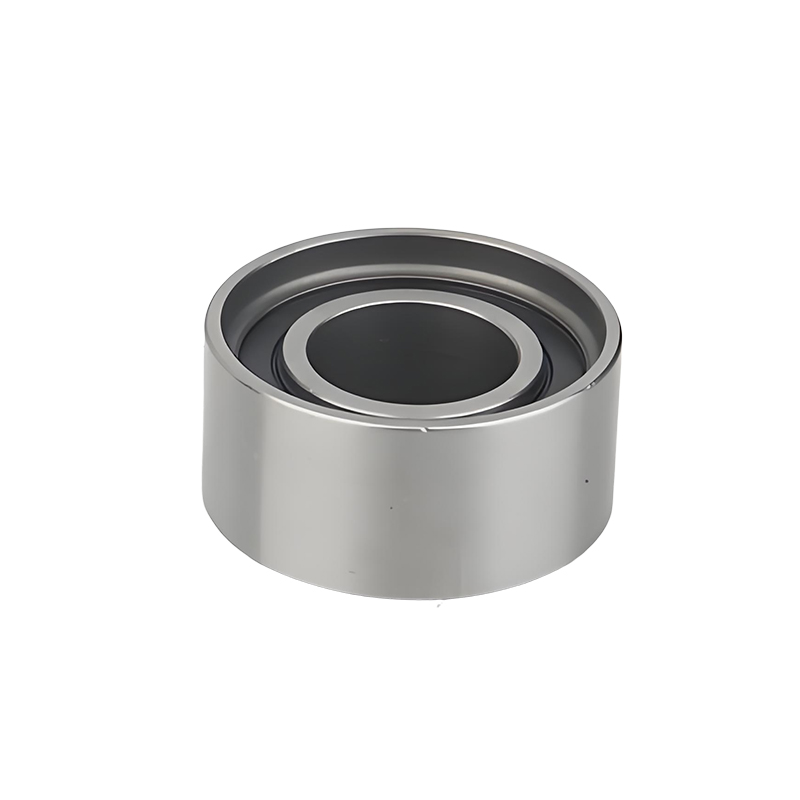
As a key component of the transmission system, the performance of the automotive tensioner bearing directly affects the stability, durability and vehicle comfort of the belt transmission. The specific performance characteristics are as follows:
1. Core functions and structural characteristics
Automatic tension adjustment
The tensioner wheel bearing is integrated into the tensioner wheel assembly, and dynamic tension adjustment is achieved through a torsion spring or hydraulic mechanism. When the belt relaxes due to wear or temperature changes, the wheel body supported by the bearing automatically moves outward to compensate for the belt elongation and maintain the optimal tension state (for example, the timing belt tension needs to be controlled within a specific range to avoid tooth skipping or breakage).
High-precision support and low-friction design
Support the rotating body: the outer ring of the bearing is combined with the wheel body, and the inner ring is fixed on the tensioning arm to ensure smooth rotation of the wheel body.
Rolling friction replaces sliding friction: using rolling bearings (such as deep groove ball bearings or angular contact bearings), the friction coefficient is 60%-80% lower than that of sliding bearings, reducing energy loss.
Rotation accuracy guarantee: The bearing clearance is controlled within ±0.01mm to ensure that the contact surface between the wheel body and the belt has no deflection and avoid belt edge wear.
structural adaptability
Integrated and separated designs: Integrated bearings integrate the iron frame with the inner/outer ring of the bearing to simplify installation; separated bearings use independent iron frames to press-fit standard ball bearings (such as type 6007) for easy maintenance.
Eccentric or spring mechanism: Some tensioner bearings have a built-in eccentric, which adjusts the initial tension through rotation; the spring mechanism absorbs the impact load of the belt through elastic deformation.
2. Environmental adaptability requirements
High temperature resistance and corrosion resistance
High-temperature environment: The temperature in the engine compartment can reach above 120°C. Bearings must use high-temperature resistant grease (such as polyurea-based grease, dropping point ≥ 250°C) and special bearing steel (such as GCr15SiMn) to prevent lubrication failure or material softening.
Water vapor and dust protection: The sealing ring adopts a three-lip medium contact structure (such as acrylic rubber) to prevent water vapor and dust from entering the bearing and avoid rust or abrasive wear.
Impact resistance and variable load capacity
Impact load: When the belt starts or accelerates rapidly, the bearing needs to withstand instantaneous impact force (up to 3-5 times the rated load). The surface hardness of the bearing steel ball and raceway is required to be ≥HRC60. The cage is made of glass fiber reinforced nylon, and the impact resistance is increased by 40%.
Variable load adaptation: The belt tension changes with the rotation speed (for example, the tension is about 200N at idle speed and up to 500N at high speed). The bearing needs to adapt to axial movement and radial load fluctuations by optimizing the outer ring channel curvature (such as contact angle 45°) and the inner ring raceway curvature.
3. Performance optimization technology
Material upgrade
Ferrules and steel balls: Use high-purity special bearing steel (such as SUJ2) with an impurity content of ≤0.005% to reduce the source of fatigue cracks.
Cage: Glass fiber reinforced nylon cage (such as PA66+GF30), with temperature resistance up to 150℃, 60% lighter than metal cage, reducing centrifugal effect.
Sealing ring: imported acrylic rubber (such as ACM), which has better oil resistance than nitrile rubber and maintains elasticity in the range of -40°C to 150°C.
Lubrication and sealing improvements
Grease: Synthetic oil (base oil) + polyurea-based (thickener) grease, with strong adhesion, can form a stable oil film, and extend the service life to more than 5,000 hours.
Sealing structure: Three-lip sealing ring design, the contact pressure between the lip and the journal is evenly distributed to prevent grease leakage and foreign matter intrusion.
Lightweight and compact structure
Outer ring channel optimization: logarithmic curve channel is used to reduce stress concentration and improve load-bearing capacity.
Cage with oil storage tank: An oil storage tank is provided on the surface of the cage to increase the grease storage capacity and reduce the grease replenishment cycle.
4. Typical application scenarios and performance verification
Automobile transmission system
Timing belt tensioner bearing: It needs to withstand the alternating load when the engine is running at high speed (speed reaches 6000rpm), and the life span is required to be ≥500 hours (according to the tensioner test conditions). For example, by optimizing the sealing structure and grease formula, Wuzhou Xinchun Bearing has a measured service life of 800 hours and a failure rate reduced to 0.2%.
Accessory belt tensioner bearing: used to drive accessories such as air conditioning compressors and generators, and needs to adapt to frequent start and stop conditions. By using high-precision steel balls and low-friction sealing rings, NTN bearings reduce noise by 3dB (A) and reduce vibration values by 20%.
Extreme environment testing
High temperature test: After continuous operation for 200 hours in an environment of 120°C, the bearing temperature rise is ≤15°C, and there is no grease deterioration or leakage.
Mud impact test: simulates wading road conditions. After being soaked in mud for 48 hours, the bearing can still maintain normal rotation without rust or sticking.